
Convenience at the Speed of a Stopwatch

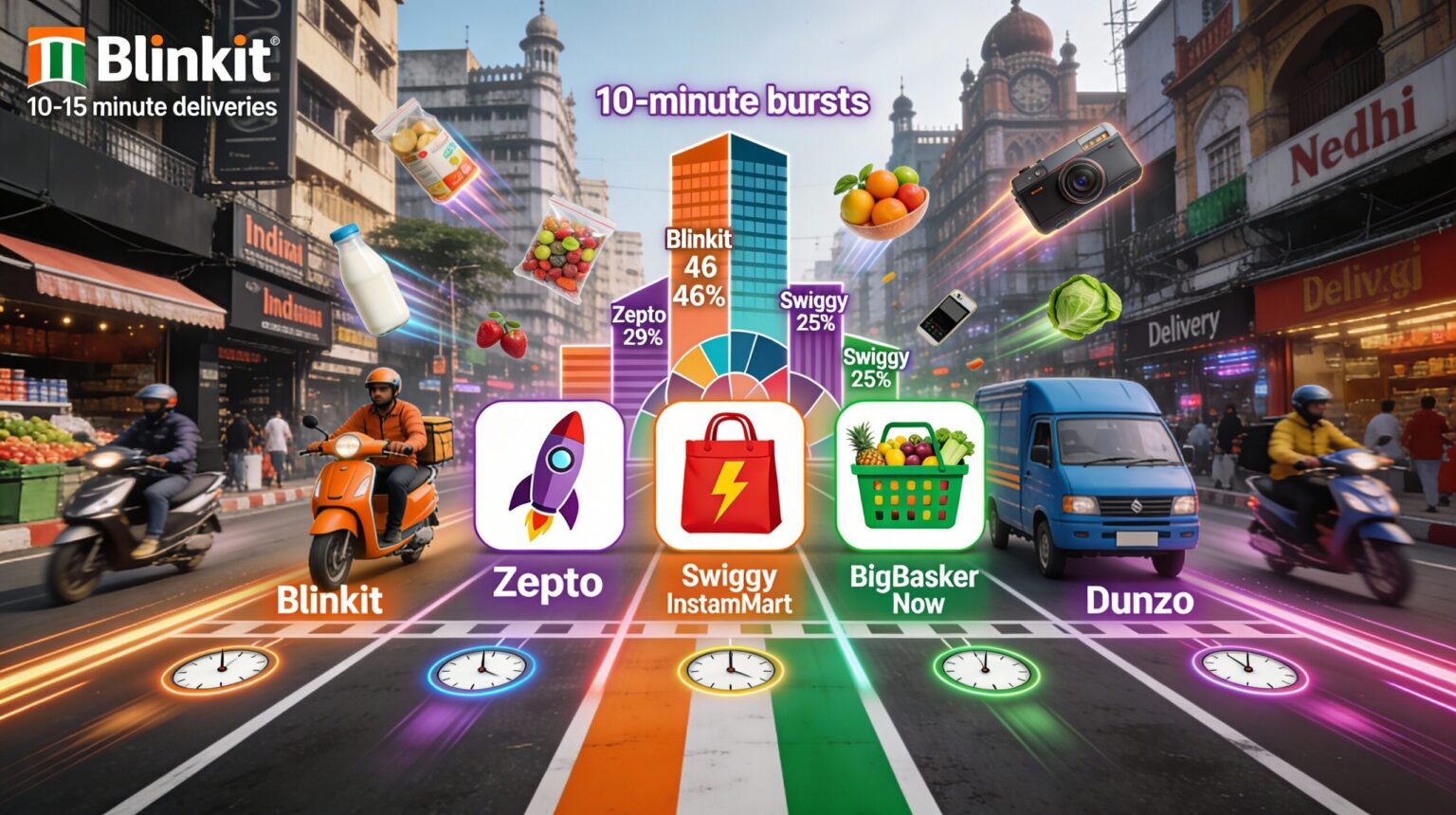
Ten minutes. That’s now all it takes in many Indian cities to get milk, vegetables, snacks, or even ice cream delivered to your doorstep. What once sounded impossible has become everyday reality, thanks to quick commerce startups promising delivery in 10 minutes.
Platforms like Blinkit, Zepto, and Swiggy Instamart have redefined convenience. They don’t just sell products — they sell instant gratification. But as the race for speed intensifies, questions are rising louder than the delivery bikes on Indian streets.
Is 10-minute delivery a breakthrough in urban living — or a business model stretched to its limits?
What Is Quick Commerce?
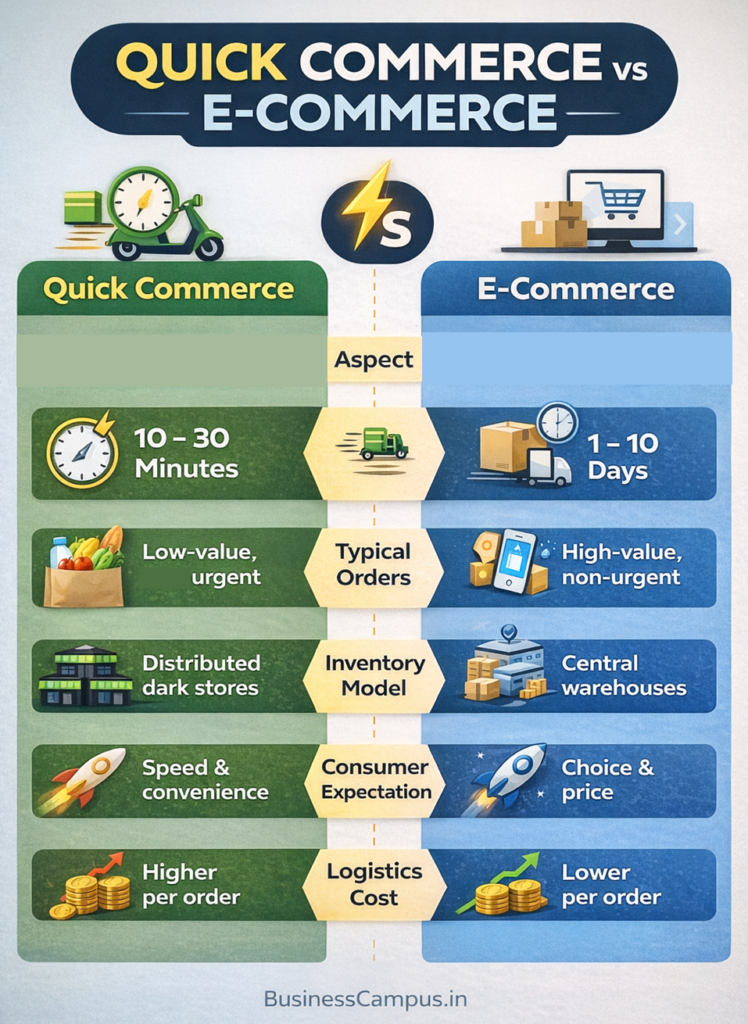
Quick commerce (Q-commerce) is a sub-segment of e-commerce focused on ultra-fast delivery, typically within 10–30 minutes, using:
- Hyperlocal dark stores
- Dense warehouse networks
- High-frequency, low-value orders
- Data-driven demand forecasting
Unlike traditional e-commerce, which optimizes for selection and price, quick commerce optimizes for time.
In simple terms:
- E-commerce = Wide choice, 1–10 days delivery
- Quick commerce = Limited choice, delivered in 10 minutes
In many ways, the evolution of quick commerce is similar to the evolution of digital payments in India — convenience and speed become the norm rather than the exception.
Market Size : How Big is the Opportunity
At broader level, it helps to position quick commerce within the broader retail landscape.
India’s retail sector is massive — contributing roughly >10% of GDP and employing millions across formal and informal markets. Within retail, e-commerce has steadily carved out a share; e-commerce sales accounted for around 8–10% of overall retail before the quick commerce disruption. ETRetail.com
India’s Retail & Digital Landscape (Approx.)
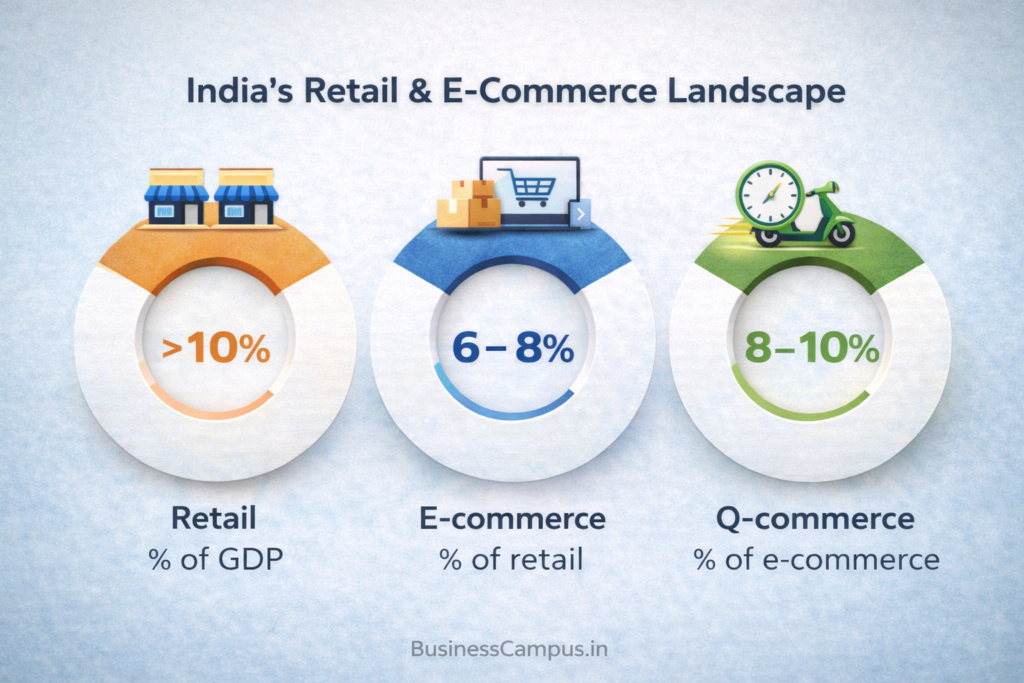
- India’s total retail market: ~$900 billion
- E-commerce as % of retail: ~6–7%
- Quick commerce as % of e-commerce: ~8–10% (urban-heavy)
While quick commerce is still a small slice, its growth rate far exceeds traditional e-commerce, especially in Tier-1 cities.
What’s remarkable is how fast quick commerce has grown within e-commerce itself:
- According to a Bain & Company and Flipkart report, quick commerce accounted for over two-thirds of all 2024 e-grocery orders and represented about 10% of total e-retail spending. Reuters
- Market research estimates put India’s quick commerce GMV (Gross Merchandise Value) at around $5.5–7 billion in 2025. Webverbal
In essence, within a few short years, q-commerce has transitioned from a niche experiment to a significant slice of the digital retail market.
Who’s Winning? Key Players in Quick Commerce
India’s quick commerce battleground brims with competition, but a few players dominate:
🔵 Blinkit
- Pioneer in express delivery
- ~45–50% market share as of 2025
- Backed by Zomato’s logistics and ecosystem.
🔴 Zepto
- Rapid entrant with aggressive funding ($450M round at $7B valuation). Reuters
- Built entirely around the deliver in 10 minutes promise and wide selection.
- Strong urban millennial adoption.
🟢 Swiggy Instamart
- Leverages Swiggy’s extensive delivery fleet and data.
- Reported 101% YoY growth in late 2025 with expanded dark store network. The Economic Times
- Leveraging food delivery density.
🏪 Others
- BB Now (BigBasket’s quick arm)
- Flipkart’s Minutes and Myntra’s M-Now
- Regional and niche players integrating quick commerce. India Briefing
Market snapshot
| Company | Delivery Time | Core Products | Market Share (approx.) |
|---|---|---|---|
| Blinkit | 10 mins | Groceries, electronics | 46% |
| Zepto | 10 mins | Groceries, dairy | 29% |
| Swiggy Instamart | 15 mins | Essentials, beauty | 25% |
| BigBasket Now | 10-30 mins | Groceries, lifestyle | Niche |
| Dunzo | 20-30 mins | Multi-category | Niche |
Together, these players continue to scale operations rapidly, pushing deeper into cities and broadening category coverage.
What’s Driving the Rise of 10-Minute Delivery?
1️⃣ Urbanization & Shrinking Time

Urban India is not just growing—it’s getting busier.
Longer working hours, rising commute times, and the steady increase in dual-income households have fundamentally changed how time is valued. In metros and Tier-1 cities, convenience now outweighs cost for a large segment of consumers (Time scarcity > price sensitivity).
For this audience, 10-minute delivery isn’t indulgence—it’s time saved, it isn’t a luxury — it’s relief.
2️⃣ Behavioral Shift: From Planned to Impulse Buying
Quick commerce thrives on moments, not on ultra low price tag:
- “Forgot milk”
- “Sudden guests”
- “Late-night cravings”
These micro-needs were never well served by traditional e-commerce or offline retail. While average basket sizes are small, order frequency is high, often daily. This creates habitual usage and keeps users repeatedly engaged with the platform.
3️⃣ Smartphone Penetration & UPI
India’s digital infrastructure has quietly played a transitional role in this revolution.
High smartphone penetration, ultra-fast internet, and UPI have eliminated friction from transactions. One-tap ordering, instant payments, and stored preferences turn impulse into action within seconds.
When checkout friction disappears, convenience consumption become effortless.
4️⃣ Venture Capital Fuel
The rapid expansion of ultra quick delivery has been powered by:
Heavy venture funding
Subsidized delivery costs
Aggressive discount-led user acquisition
This capital allowed companies to build dense dark-store networks to be able to deliver in lightening fast speed with precision.
But all of these brings us to the uncomfortable question.
But at What Cost?
The rise of ultra quick delivery has undeniably transformed urban convenience. But beneath the speed lies a set of economic and social trade-offs.
1️⃣ Unit Economics Under Pressure

Delivering in 10 minutes is not just a logistics challenge—it’s a financial one.
To make this promise work, quick commerce companies must operate dense networks of dark stores, often located in premium urban neighborhoods where rents are high. Inventory must sit idle close to consumers, increasing holding costs and wastage risks. At the same time, platforms need a large pool of delivery riders on standby to meet unpredictable spikes in demand.
Even at scale, last-mile delivery costs refuse to compress. Unlike traditional e-commerce, where one rider delivers multiple high-value orders in a single trip, q-commerce runs on small baskets and frequent trips.
In simple terms: Faster delivery = higher cost per order
Speed, while attractive to consumers, is structurally expensive.
2️⃣ Rider Safety & Work Conditions
Much of the public backlash against 10-minute delivery revolves around one question: who pays the price for speed?
Delivery riders face constant pressure to meet tight timelines, often navigating congested roads, weather conditions, and traffic unpredictability. While platforms officially deny enforcing unsafe speeds, algorithmic incentives—ratings, bonuses, penalties—create indirect pressure.
When earnings depend on faster completion times, the system nudges behavior even without explicit commands. Road safety risks, physical fatigue, and mental stress become invisible costs embedded into the model.
The delivery may be fast—but the human toll is slower and harder to measure.
3️⃣ Sustainability Concerns
Quick commerce raises environmental flags.
Each small order triggers a separate delivery trip, increasing the carbon footprint per items. Unlike consolidated e-commerce deliveries, quick commerce prioritizes speed over efficiency. Add to this the surge in packaging-plastic bags, insulated boxes, single-use wrappers-and the sustainability equation worsens.
Convenience, as it turns out, comes with a price tag.
4️⃣ Market Consolidation Risk
Here is a cautionary tale.
Food delivery, airlines, telecom—every speed-driven or capital-intensive industry eventually enters a phase where price wars eliminate weaker players. What follows is consolidation. Once only two or three platforms remain, discounts fade and prices quietly rise.
If quick commerce narrows down to a few dominant players, today’s convenience could become tomorrow’s dependency.
Speed wins markets—but monopolies decide the price.
The Future of Quick Commerce in India
Fewer players, stronger balance sheets
Smaller or inefficient players will either exit, merge, or get acquired. What will remain are fewer platforms with deeper pockets, tighter cost control, and clearer paths to profitability. Market leadership will be defined less by how fast a company expands, and more by how well it manages cash.
Higher minimum order values
To improve unit economics, platforms will gradually push users toward larger basket sizes. This may come through minimum order thresholds, bundled offers, or delivery fees for smaller carts.
The aim is simple: fewer trips, higher revenue per delivery. Speed will remain important, but not at the expense of financial sanity.
Subscription-based models
Subscriptions will become a key lever.
Monthly or annual plans offering free deliveries, priority slots, or exclusive discounts help platforms lock in repeat usage while generating predictable revenue. For consumers, subscriptions justify frequent ordering; for companies, they smooth demand and improve planning.
Smarter demand forecasting
Data will do more heavy lifting.
Advanced forecasting models will reduce idle inventory, improve stock rotation, and limit wastage. Dark stores will become more specialized, stocking fewer SKUs but in smarter quantities, based on hyperlocal consumption patterns.
Efficiency, not expansion, will define operational excellence.
Speed is a feature, not a business model
The rise of ultra fast delivery reflects modern India’s hunger for convenience. But history shows us one thing clearly:
Businesses built only on speed eventually slow down.
Quick commerce will stay. But 10-minute delivery as a headline promise may not. Industry will eventually prioritize profitability over speed. The narrative will move away from:
“How fast can we deliver?”
Toward:
“How efficiently and sustainably can we serve?”
Delivery times may stretch slightly—from 10 minutes to 20—but margins will improve, riders will face less pressure, and operations will stabilize.
Are you an emerging business enthusiast? Ready to build your own million-dollar empire? Discover how Zoho built $1B Empire from nowhere. Read more here.
How You Can Tap into Quick Commerce Opportunities
Dark store for quick commerce rentals offer high passive income with minimal operational risk, capitalizing on its explosive growth.
Explosive Market Demand
Dark store networks are set to triple 40000+ by 2030, driven by Blinkit, Zepto and Swiggy expanding into every urban pincode amid 50% YoY order surges.
Landlords secure long-term leases (3-5 years) as platforms prioritize stable real estate over building their own.
Low-Risk Advantages
| Factor | Benefit for Landlords |
|---|---|
| Entry Barrier | Commercial space + basic fit-out only |
| Risk Profile | Guaranteed rent, no sales dependency |
| Scalability | Multi-store portfolios across cities |
| Exit Flexibility | High resale value in booming sector |
Strong Financial Returns
Earn ₹50,000-₹2.5 lakh monthly rent per 2,000 sq ft store in metros like Kolkata, with 20-30% ROI after low setup costs (₹15-50L including interiors).
No inventory or staffing hassles—platforms manage stock, riders, and operations, passing 100% rent directly.