
Car companies spend billions building smart factories, powerful brands, luxurious advertising. Smart money are build on the same roads those cars drive on — and collect rent forever. A far more powerful business model operate in plain sight — toll roads.
Car companies fight for customers.
Toll booths wait for them.
One sells discretionary products in a fiercely competitive market.
The other collects a mandatory fee from almost everyone who passes.
From a pure business model lens, toll road business is one of the most underrated, predictable, and inflation-proof businesses — especially when compared to automobile manufacturing.
Let’s decode why.
The Scale of the Opportunity: Roads vs Cars
India today has over 6.3 million km of road network, the second largest in the world. National Highways alone account for ~145,000 km, carrying over 40% of total road traffic despite being less than 3% of the total network.
Now consider this:
- India has ~340 million registered vehicles, including ~40 million cars.
- A single toll plaza typically serves 40–60 km of highway stretch.
- On busy corridors, 50,000–100,000 vehicles pass through a toll plaza daily.
Cars are many.
Toll booths are few — and unavoidable.
This asymmetry is the foundation of the toll booth business.
Where Does Toll Money Go in India?
Contrary to popular belief, toll collection isn’t a simple “tax.”
In India, toll money typically flows into three buckets:
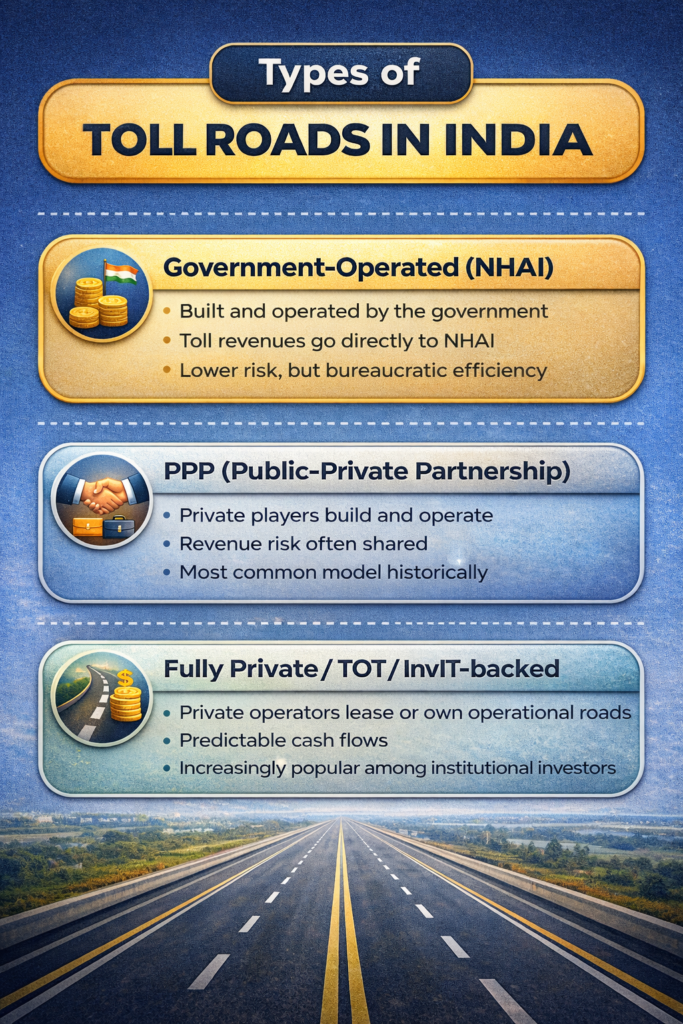
- Debt servicing – Repayment of loans used to build highways
- Operations & maintenance – Road upkeep, staff, technology
- Returns to concessionaires – Private players, InvITs, or government agencies
Most toll roads operate under long-term concessions (15–30 years), during which the operator has exclusive rights to collect tolls.
Once debt is largely paid down, margins expand dramatically.
What Technology Is Used in Toll Collection?
Technology has quietly transformed toll plazas into high-efficiency cash machines.
Key systems include:
- FASTag (RFID-based collection) – Over 98% penetration on national highways
- Automated Vehicle Classification (AVC) – Identifies vehicle type accurately
- ANPR cameras – Number plate recognition
- Centralized transaction reconciliation – Real-time settlement
- Electronic toll rate updates – Annual inflation-linked revisions
Unlike car companies that must constantly innovate products, toll operators invest once in technology and scale efficiency across decades.
Toll Road Business Model & Revenue
Core Concept
You don’t sell a product. You monetize mobility.
Every vehicle passing through becomes a micro-transaction.
Revenue Sources
- Toll collections (primary)
- Penalties & exemptions adjustments
- Advertising & wayside services (minor)
Key Drivers
- Traffic growth (economic activity)
- Inflation-linked toll hikes
- Route monopolies
- Urbanization & logistics demand
Importantly, you don’t need marketing, discounts, or branding.
Read more on how instant demand creates unbeatable business models:👉 The Rise of 10-Minute Delivery & Quick Commerce
Key Components & Operations
Financing: High Capex, Patient Capital, Annuity cash flow
- High upfront capex:
Building a 4–6 lane highway in India typically costs ₹25–40 crore per km, depending on terrain, land acquisition, and structures (bridges, flyovers). Nearly 70–75% of total project cost is incurred before a single vehicle passes through the toll booth. - Long-tenure debt (15–20 years):
Toll road projects are financed using project finance, with 60–70% debt and 30–40% equity. Banks and institutions lend for 15–20 years, aligned with concession periods. This reduces annual repayment pressure and improves cash flow predictability. - Once stabilized = annuity-like cash flows:
Once traffic stabilizes (usually 2–3 years after commissioning), toll collections become highly predictable. Traffic growth of 5–7% annually combined with inflation-linked toll hikes turns the toll road business into a quasi-bond with equity upside.
Unlike car companies, which must reinvest continuously in plants, models, and inventory, toll roads front-load capex once and monetize for decades.
Technology: High Leverage, Near-Zero Marginal Cost
Technology is where the toll booth business quietly compounds efficiency.
- One-time investment:
Systems like FASTag (RFID), ANPR cameras, automated barriers, and central clearing houses require upfront setup, but upgrades are infrequent. Once installed, these systems run for years with minimal incremental cost. - Marginal cost per transaction ≈ zero:
Whether 10,000 vehicles or 100,000 vehicles pass daily, the cost of processing each additional vehicle is negligible. Unlike car manufacturing—where each unit adds material, labor, and logistics cost—toll roads benefit from pure operating leverage. - Reduced leakage and higher realization:
FASTag penetration crossed >95% in India, cutting cash handling, fraud, and queue times. This improves net toll realization without increasing prices—a hidden margin expansion lever.
Technology turns toll roads into high-volume, low-cost digital transaction platforms, not physical businesses.
Management
The operational structure of a toll road business is strikingly lean.
- Small core teams:
A toll road asset generating ₹100–300 crore annually can be managed by a core team of 10–20 professionals covering finance, compliance, and asset monitoring. - Outsourced operations:
Toll collection, maintenance, and security are largely outsourced to EPC and O&M contractors. This converts fixed costs into variable costs and keeps balance sheets clean. - Minimal human intensity:
Compare this with car factories employing thousands of workers, union risks, production downtime, and quality issues. Toll roads run 24/7 with far fewer people and lower execution risk.
The result: high asset value, low managerial complexity, and exceptional scalability—hallmarks of a better business model.
Why Tolls Are Better Business Than Car Companies
This is where the contrast becomes stark.
Profitability & Payback
- 1 km of highway in India costs ~₹8–12 crore depending on terrain (Plains: ₹7–8 cr | Hilly/urban: ₹10–12+ cr).
- High-traffic toll roads often recover capital within 8–12 years.
Remaining concession period becomes high-margin cash flow.
Car companies?
- Operating margins typically 5–10%
- Heavy capex cycles
- Constant reinvestment in new models
- New platforms
- Model refreshes every 3–5 years
- EV transition investments
Toll plazas, once stabilized, can generate 30–60% EBITDA margins.
Cyclical vs Steady
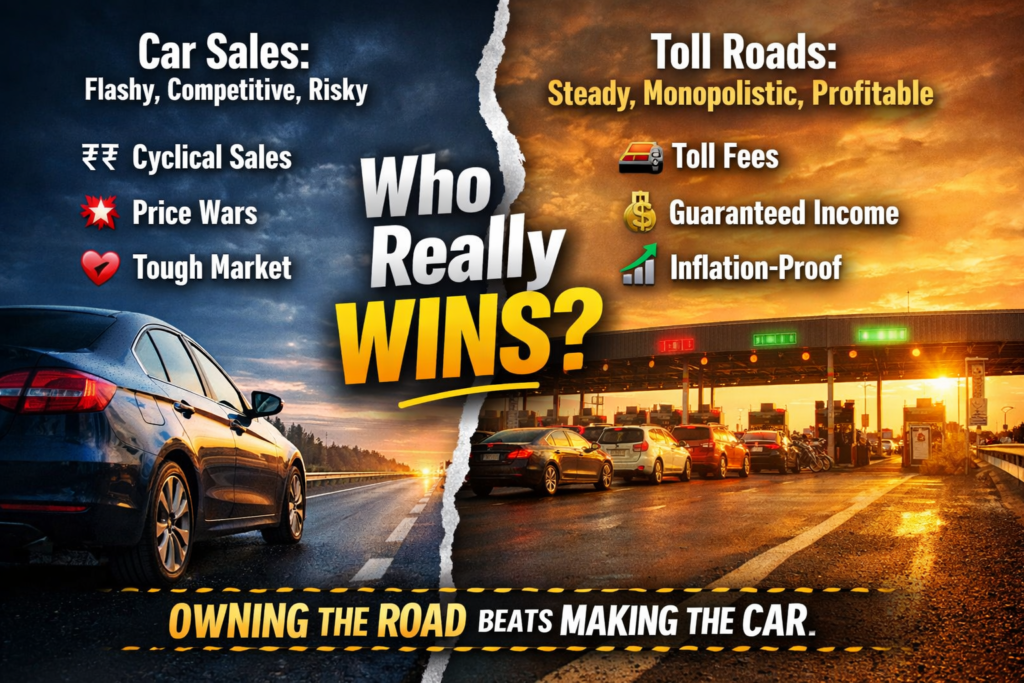
Car sales are:
- Highly Cyclical
- Dependent on income, credit, sentiment
- Vulnerable to recessions
Toll road business benefits from:
- Inelastic demand
- Freight movement continuity
- Essential commuting
Even during slowdowns, vehicles keep moving.
Competition vs Monopoly
Car companies face:
- Intense competition
- Price wars
- Feature commoditization
A toll road:
- Has zero competition
- Controls a specific route
- Cannot be bypassed easily
It’s a geographic monopoly by design.
Inventory vs Zero Inventory
Car manufacturers:
- Manage raw materials
- Finished goods inventory
- Dealer stock
Toll booths:
- No inventory
- No working capital cycles
- Cash collected upfront
This makes toll road business asset-heavy but operationally simple — a rare and powerful combination.
Inflation Proof & Zero Churn
- Toll rates are revised annually, often linked to WPI/CPI
- Customers cannot “switch” to another toll operator
- No loyalty programs needed
In business terms:
Zero churn. Guaranteed demand. Built-in pricing power.
Opportunities & Growth Ahead
Massive Highway Expansion
India has ~5.13 km of road per 1,000 people.
Compare this to:
- USA: ~20.5 km
- Japan: ~19 km
The gap is enormous.
Programs like Bharatmala Pariyojana aim to add 65,000+ km of highways, creating sustained demand for private capital.
Investment Vehicles: InvITs
Infrastructure Investment Trusts allow:
- Retail & institutional participation
- Stable yields (8–12%)
- Inflation-protected cash flows
Toll roads are increasingly viewed as bond substitutes with growth.
Government Support
- Policy clarity
- Monetization of operational assets
- Reduced construction risk for private players
The state builds. Private capital monetizes.
The Ultimate Money Maker
Car companies sell dreams. Toll booths collect reality.
One fights for customers every year. The other waits patiently as traffic compounds.
From a pure business model perspective, toll road business checks almost every box investors dream of:
- Predictable revenue
- Monopoly characteristics
- Inflation protection
- Low churn
- Long-term visibility
Cars may define mobility. Tolls define monetization.
Further reads: